
What an Anaheim Resident Lookup Can Confirm
A name search is only as good as the record behind it. The Orange County Assessor can confirm a parcel connection, but ownership is not occupancy. RecorderWorks can show a grantor or grantee and a transfer date. The Orange County Superior Court can show parties, roles, cases, and register events. Vital records can establish a family or event link when the requester's access fits the rule. Licenses and business filings can show public roles and addresses.
Use a second anchor before accepting a match. An old Anaheim address, middle initial, age, relative, occupation, parcel, entity, or case number can separate two people with the same name. The table below is a map of the evidence, not a promise that every source is open to every requester.
| Record | What it confirms | Where | Access |
|---|---|---|---|
| Property | Ownership, situs, tax mailing address | Orange County Assessor | APN search; fuller roll at counter or by request |
| Deed | Name variants, transfer, grantor and grantee | Orange County Clerk-Recorder | Free index from 1982; copies separate |
| Voter | Individual registration and status | Orange County Registrar | Self-lookup or qualified file request |
| Court | Party role, case, judgment, probate lead | Orange County Superior Court | Paid name search; number lookup is free |
| Vital | Identity, family, and event connection | OC Recorder or CDPH | Authorized or informational copy rules |
| Business or license | Entity, public role, filing or business address | California and Anaheim offices | Free indexes with field limits |
| Unclaimed property | Prior city, address, or holder lead | California State Controller | Free search; proof required to claim |
Build One Anaheim Identity Anchor
Start with the person's full name and the strongest non-sensitive clue available. An old Anaheim address is often more useful than a broad search because it can be tested against a parcel, deed, directory, or newspaper. A middle name, approximate age, relative, occupation, business, or case number can serve the same role. Write the clue down before searching so the first plausible result does not reset the question.
Then compare dates and roles. A deed party should fit the parcel and transfer date. A court party should fit the case category and location. A license record should fit the public profession and city field. A business filing should fit the entity and filing history. A match that only shares a common name should remain unconfirmed.
- Write the full name and one anchor such as address, age, relative, parcel, entity, or case.
- Test spelling, initials, married or maiden names, hyphenation, and multi-surname order.
- Use property or deed records to connect a name to a place without equating ownership with occupancy.
- Compare court, license, business, vital, directory, or obituary dates.
- Accept the match only when a second independent identifier fits.
Test Anaheim Name Variants
Indexing choices can hide a record. Search a surname with a partial first name, then test an initial. Try a married or maiden surname, a hyphenated form, and a different order for a multi-surname name. Older Anaheim materials may contain German spellings, handwritten German, OCR mistakes, or an address listed under an earlier street name.
A no-result screen does not carry the same meaning in every system. RecorderWorks begins its online index in 1982. A directory may be physical only, or the digital OCR may miss the printed line. A court name search may require the correct category and paid credits. A voter tool is not a browseable third-party roll. Change the search path before deciding that the person is absent.
Variant habit. Keep a short list of every spelling and address form tested. It prevents a later search from treating the same person as a new lead.
Navigate Orange County's Paid Court Name Search
Orange County Superior Court serves Anaheim for civil, small claims, criminal, traffic, family, probate, and juvenile matters. The public name-search portal asks for a person or business name, category, and search action. Name searching uses credits and requires enrollment. The court lists one credit at $1.50, five at $5, ten at $9, seventy-five at $70, and an unlimited thirty-day option at $400. A direct case or citation number remains the free follow-up route.
Use the court's Case Access landing page to choose the right category. The online party index is not the official case file. For a record or certified copy, use the clerk's records-copy route and the required L-3009 form. Criminal mail requests are generally filled in 7-10 working days. Older indexes can be held at justice centers, and remote access is narrower for confidential or sealed cases.
Start with Orange County Civil Case Access when the clue is a party name, and check the court access overview for category limits. The court name-search terms explain the paid name route.
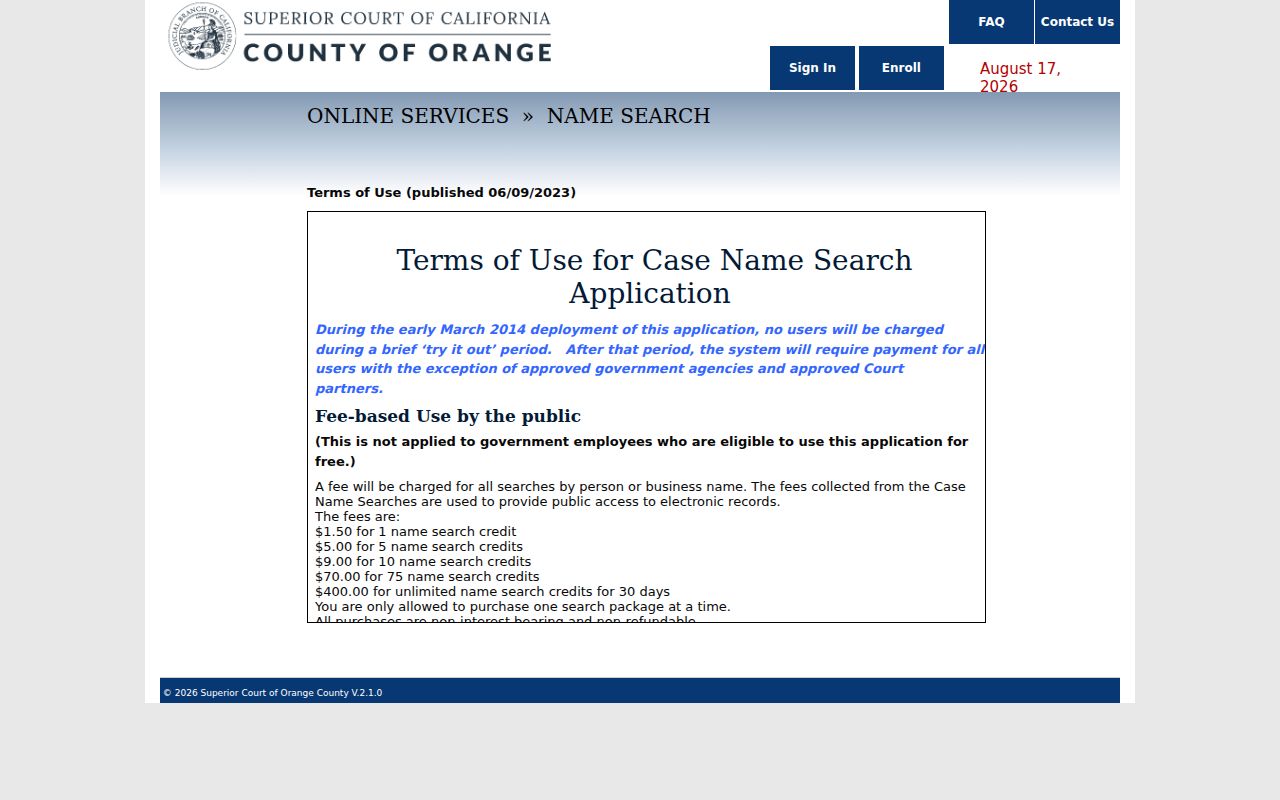
The court name-search image shows the paid name path. A known case number is a different, simpler search.
What an Anaheim Court Result Contains
A typical Orange County result may expose the case number, title, case type, filing date, court location, party names and roles, status, register of actions, hearings, department, judicial officer, disposition, and a document list. Treat each field as a clue with a defined meaning. A party role is not the same as a finding, and a case listing is not the same as the underlying document.
Traffic citations may take up to 21 days to appear. Most unlimited civil files can be viewed on Central Justice Center computers, while limited and small-claims files are held at local justice centers. Family-law public computers can show material that is not remote. Adoption, most juvenile records, sealed cases, and other confidential material are not available through a broad name search.
| Result field | Meaning for a resident lookup |
|---|---|
| Party name and role | Identifies a person or entity's place in the case. |
| Status and disposition | Shows procedural or outcome information, not a full narrative. |
| Register of actions | Lists docket events and filings in sequence. |
| Document list | Points to available images or copy-request options. |
- Docket
- The ordered record of case events and filings.
- Index
- A pointer to a case or record, not necessarily the image.
- Disposition
- The recorded procedural or case outcome.
- Certified copy
- A court-issued copy carrying the clerk's certification.
Verify an Anaheim Vital Event
Vital records are not one open name index. Orange County issues Orange County birth, death, and marriage certificates. CDPH supplies statewide certificates and divorce certificates of record for covered years. California distinguishes an authorized certified copy from an informational copy. Eligible relatives and other qualified requesters may seek an authorized copy. Others can generally seek an informational copy marked as not valid to establish identity.
The county form asks for the record type, event city and date, names, relationship, contact data, copy choice, and payment. Mail requests for authorized copies require a notarized sworn statement. Confidential marriage records are available to a spouse or by court order. A divorce certificate is not the Superior Court decree. Keep the event, custodian, and copy type aligned.
Use the California Department of Public Health vital-record route for eligibility and forms. The route may confirm a family or event link without exposing a current address.
Anaheim Voter Records Have Limits
The Orange County voter status tool is designed for an individual to check registration, ballot, and district information. The dynamic form typically asks for first name, last name, date of birth, house number, and ZIP Code. The research notes that labels can change, so verify the live form rather than promising an exact field list.
California voter-file access under Elections Code section 2194 is purpose-limited. Approved election, governmental, scholarly, journalistic, political, and defined record-review uses can qualify. Personal or commercial communication, solicitation, harassment, fraudulent use, and sending the data outside the United States are prohibited. A full-file request needs a qualifying purpose, identification, wet signature, advance payment, and security plan.
An Anaheim resident lookup should therefore use voter data only through the lawful self-lookup or approved request route. It is not a substitute for a public street directory.
Find Anaheim Heirs and Classmates
Different personal questions call for different records. An heir trail can begin in a probate petition, notice, deed, obituary, and estate transfer. A birth-parent or adoptee question must use California adoption-consent, court, and CDPH sealed-record channels. A former classmate search fits yearbooks, library history, alumni material, and photographs. A business-owner question can compare Secretary of State filings, Orange County fictitious-business-name records, Anaheim licenses, and state license boards.
Official indexes can also supply narrow leads. The State Controller's unclaimed-property search accepts an owner name and may show a reported city or holder, but the claimant must prove ownership. The California license search can filter by board, name, license number, city, or county. The Secretary of State search can show entity formation, status, addresses, agents, officers, and filing history. None of these records alone proves where a person lives now.
Use California unclaimed property search for a possible prior-city clue, then return to the custodian named in the result.
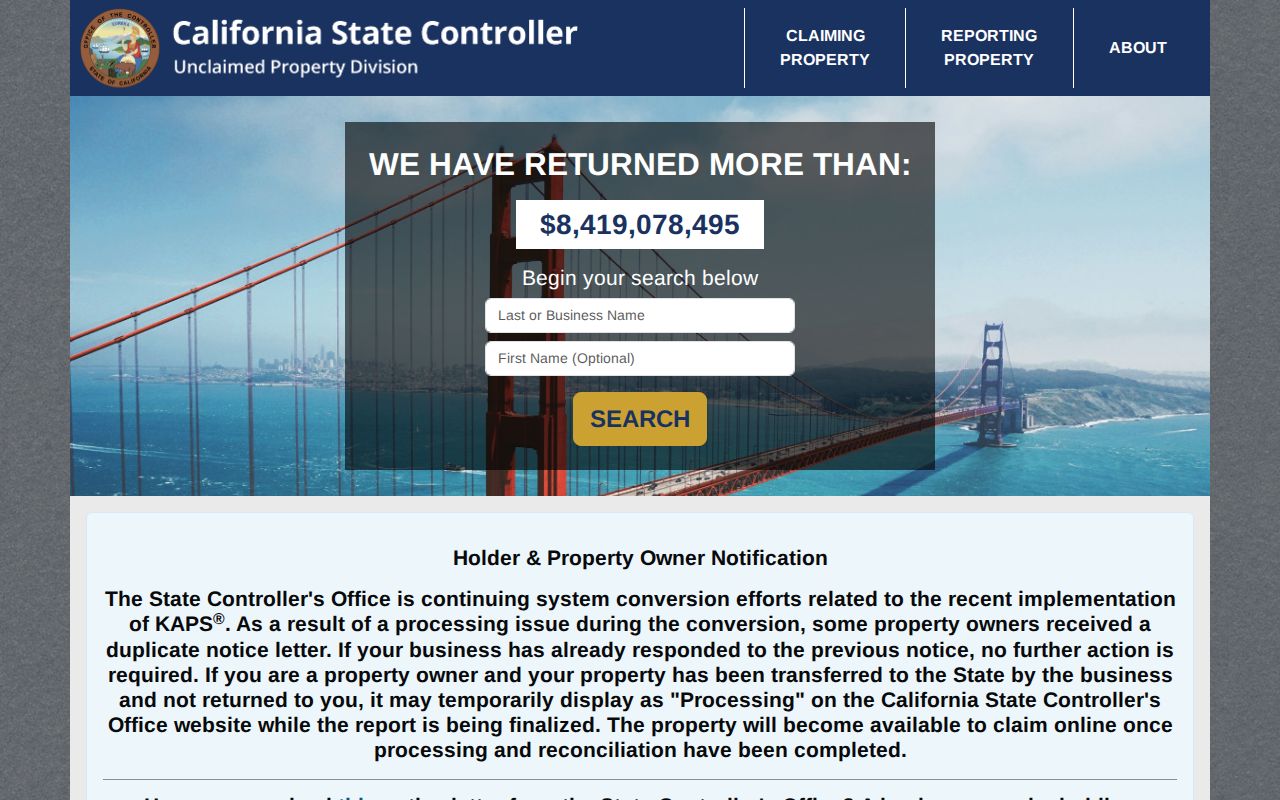
The unclaimed-property image shows a lawful lead source that still requires proof and should not be treated as an identity certificate.
For a professional-role clue, the California State Bar attorney search can test a name or bar number and show the public status fields supplied by that custodian.
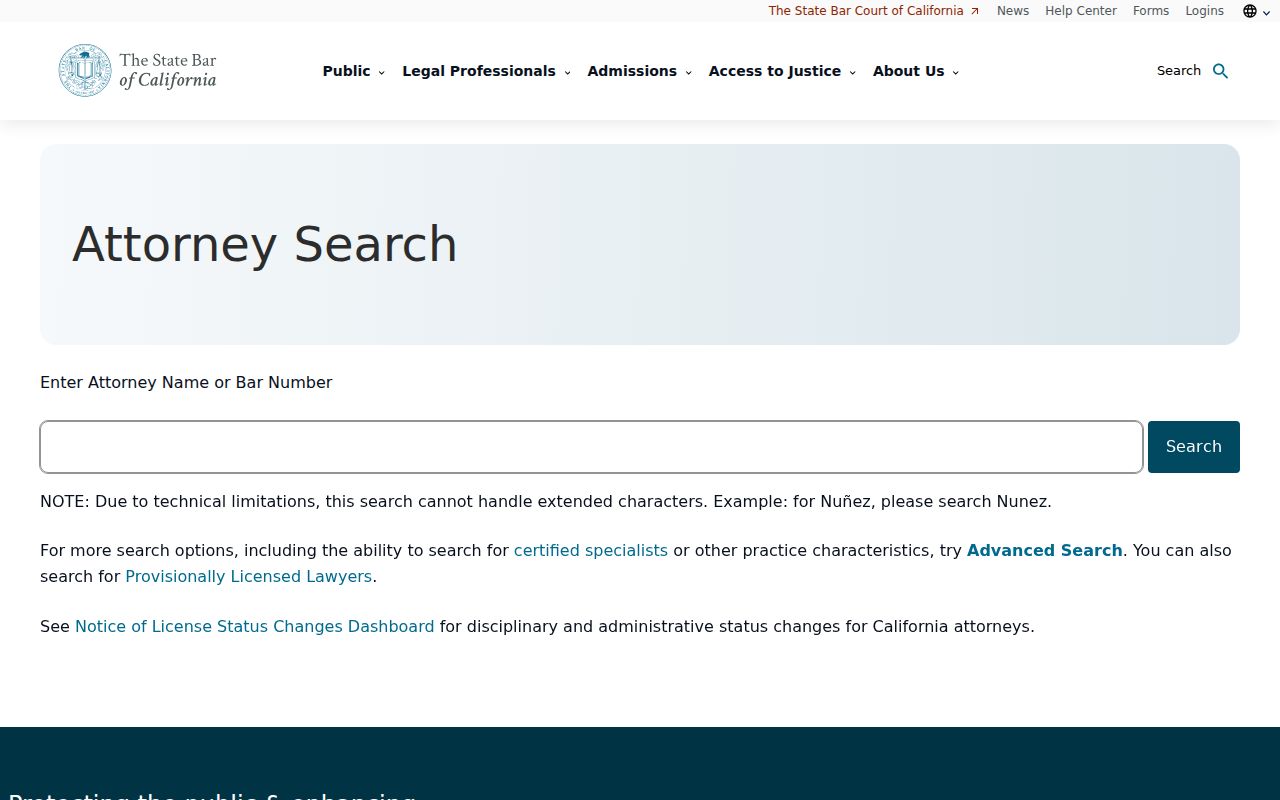
A license result is an official role record. It can support identity matching when dates and names fit, but it does not prove a current Anaheim address.
The California real-estate license lookup is another public role source for a name or license clue.
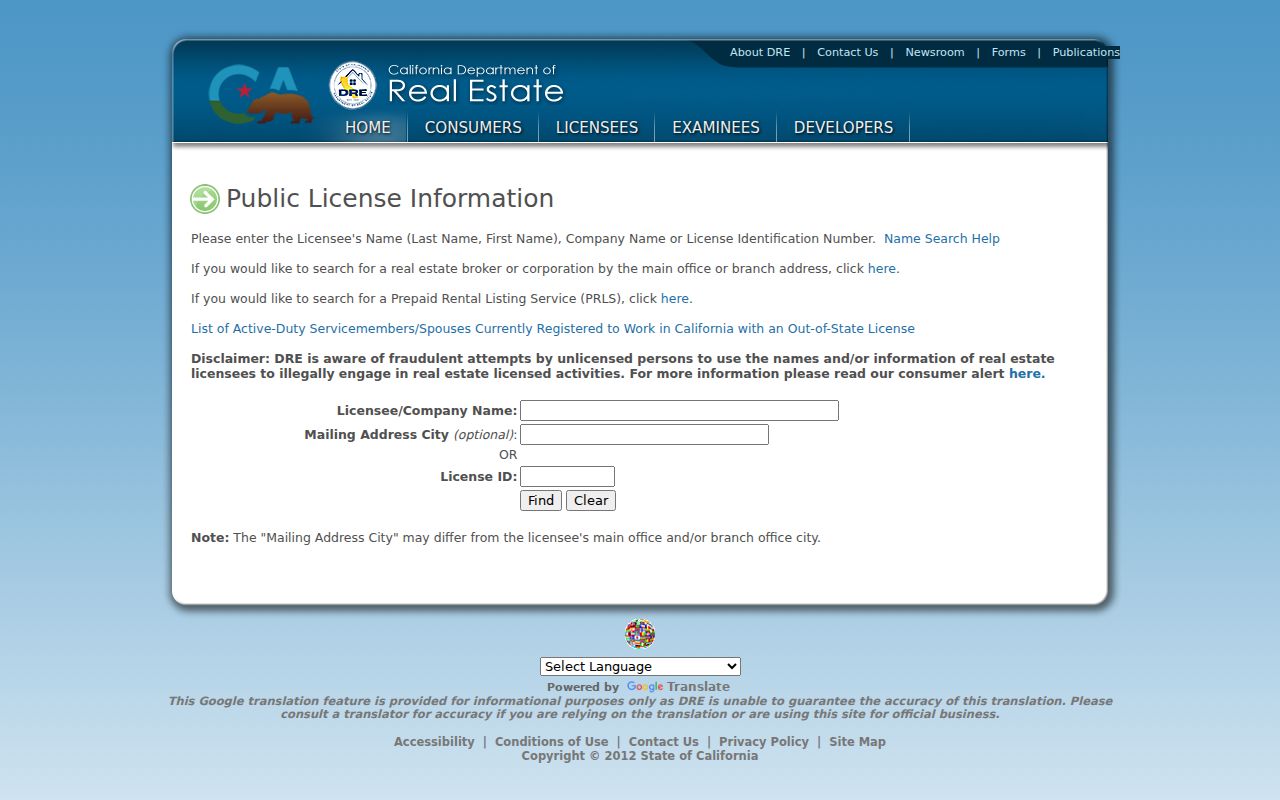
The real-estate license image belongs with the business and professional trail, where a public license is an affiliation clue rather than proof of residence.
When an Anaheim Resident Lookup Must Stop
Some records are sealed, confidential, or purpose-restricted. Adoption and most juvenile court material are not open. Authorized vital copies require an eligible relationship or other recognized authority. Safe at Home participants can use a substitute address and confidential voting. DMV data and utility customer data do not become public because a name search is difficult.
A missing match may mean the person changed a name, moved, used a different address, appears in an unindexed source, or is protected by law. Do not ask a clerk to find a person across unrelated systems. Request a defined existing record, and contact the custodian when a result is wrong. That is more accurate and safer than repeating a commercial aggregate.
Lawful use. An Anaheim resident lookup is for lawful personal research, family history, reconnecting, or civic understanding. Do not use records to stalk, harass, intimidate, or harm anyone.
California's Safe at Home program explains why some public systems show a substitute address or no ordinary address at all.
Correct a Wrong Anaheim Match
When a resident lookup produces a wrong match, return to the office that created the record. A court question belongs with the Superior Court clerk. A vital-copy issue belongs with Orange County or CDPH. A license field belongs with the board or Department of Consumer Affairs. A deed or index problem belongs with the Clerk-Recorder. A parcel or value issue belongs with the Assessor or the city GIS custodian.
Keep the record number, search date, spelling used, field that conflicts, and the second identifier that supports the correction. Do not circulate an unverified name while asking another source to repair it. The official source can explain whether the issue is a stale field, a same-name collision, a protected record, or a request that needs a different access path.
A careful Anaheim resident lookup ends with a source citation and a limit statement. It does not turn a plausible lead into a fact simply because several summaries repeat it.