
Anaheim Sources for Previous Residents
An address history needs a source for each era. The online RecorderWorks index begins in 1982 and identifies parties, types, dates, and instrument numbers, but it has no web images. Orange County Archives preserves historic county material, including documented property index volumes from 1889-1953. The Heritage Center adds directories, newspapers, maps, photographs, and local collections. Building permits provide a post-1950 work trail, while federal census schedules reach 1850-1950 under the public release rule.
The table separates title, occupancy, building, and household evidence. “Previous residents” can mean former owners, listed occupants, or people found in a household source. State which meaning the search uses before combining records.
| Source | Years it covers | Where held | What it shows |
|---|---|---|---|
| RecorderWorks index | 1982-present | Online | Parties, type, date, instrument number; no image |
| Historic property indexes | 1889-1953 documented | Orange County Archives | Grantor, grantee, book and page bridge |
| County Archives records | Mostly before 1960 | Old Courthouse | Deeds, property, county and vital material |
| Anaheim permits | After 1950 | Building Division | Construction, alterations, contractors, owner-builder clues |
| Local newspapers | 1850-present on microfilm | Heritage Center | Sales, obituaries, notices, addresses |
| Directories and census | Directories vary; census 1850-1950 public | Heritage Center and NARA/library access | Listed occupants and ten-year household snapshots |
Begin with Today's Anaheim Parcel
Do not start a house history by guessing a former name. Search the exact situs in Anaheim Property Info or the Orange County Treasurer-Tax Collector address search. Preserve the APN, legal description, ZIP, annexation date, and map context. The parcel is the fixed object that lets a name change over time without losing the property.
Keep the situs and mailing address separate. The situs is the physical property. The mailing address is where assessment notices go and may be elsewhere. A tax bill can still carry the January 1 lien-date owner's name after a sale. The Assessor's free APN result suppresses owner name, so use the counter or written route for fuller roll information.
For a visual route, see the Orange County Assessor roll products information before requesting a map, roll copy, or related product.
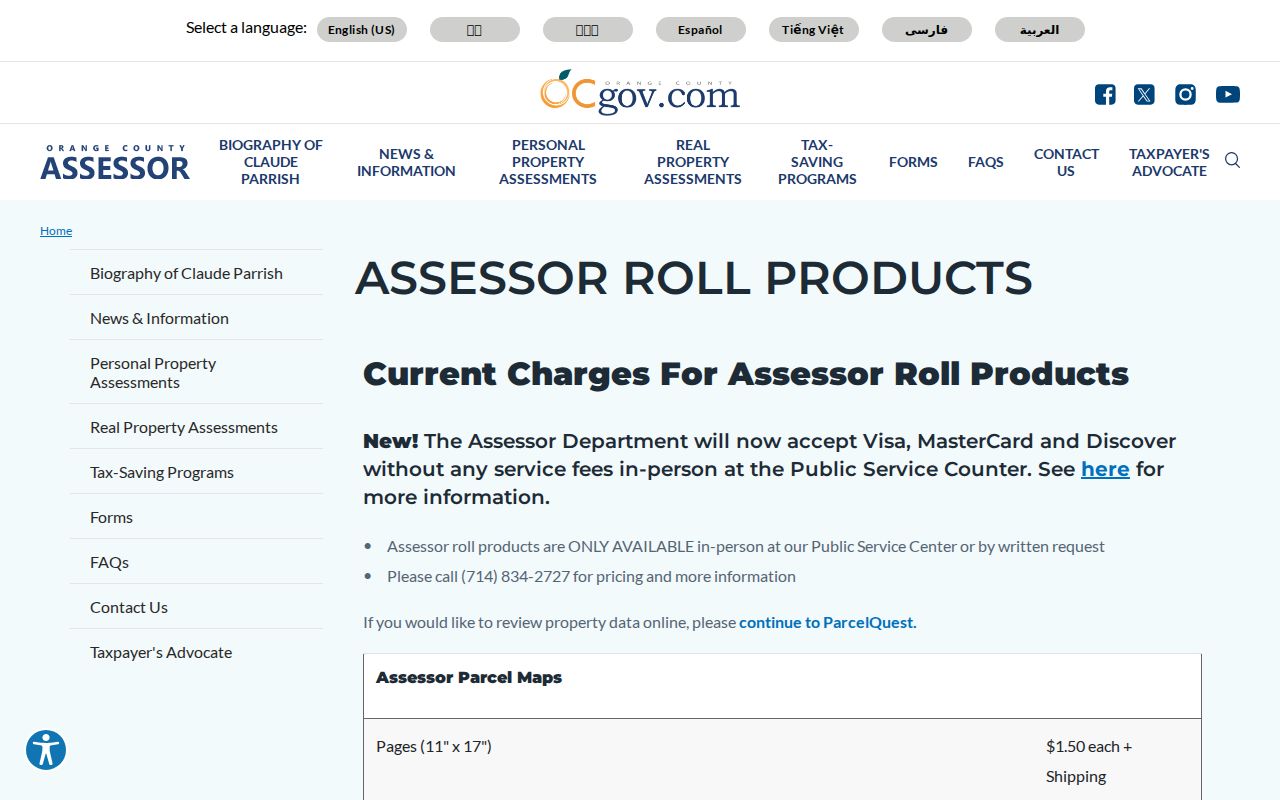
The Assessor image represents the parcel and roll side of the previous-residents trail, not a complete occupancy list.
Find the Current Acquisition Deed
Once the parcel and current owner are anchored, search the owner as Grantee in RecorderWorks. Use the `LAST FIRST` format, add a partial first name when needed, narrow the date, and choose a document type. The acquisition deed should identify the seller as grantor, the recording date, and the instrument number. Save those fields before moving backward.
RecorderWorks does not show the image. The county directs a researcher to find the instrument number first, then order a regular or certified copy. The Clerk-Recorder's web index is free, while copies are $1 per page plus $1 certification per document or map. A mail request needs a self-addressed stamped envelope and payment. County staff do not perform the search by phone, mail, or at the counter.
Use the Orange County Grantor-Grantee Index for the search, and the official-copy route for the instrument once its number is known.
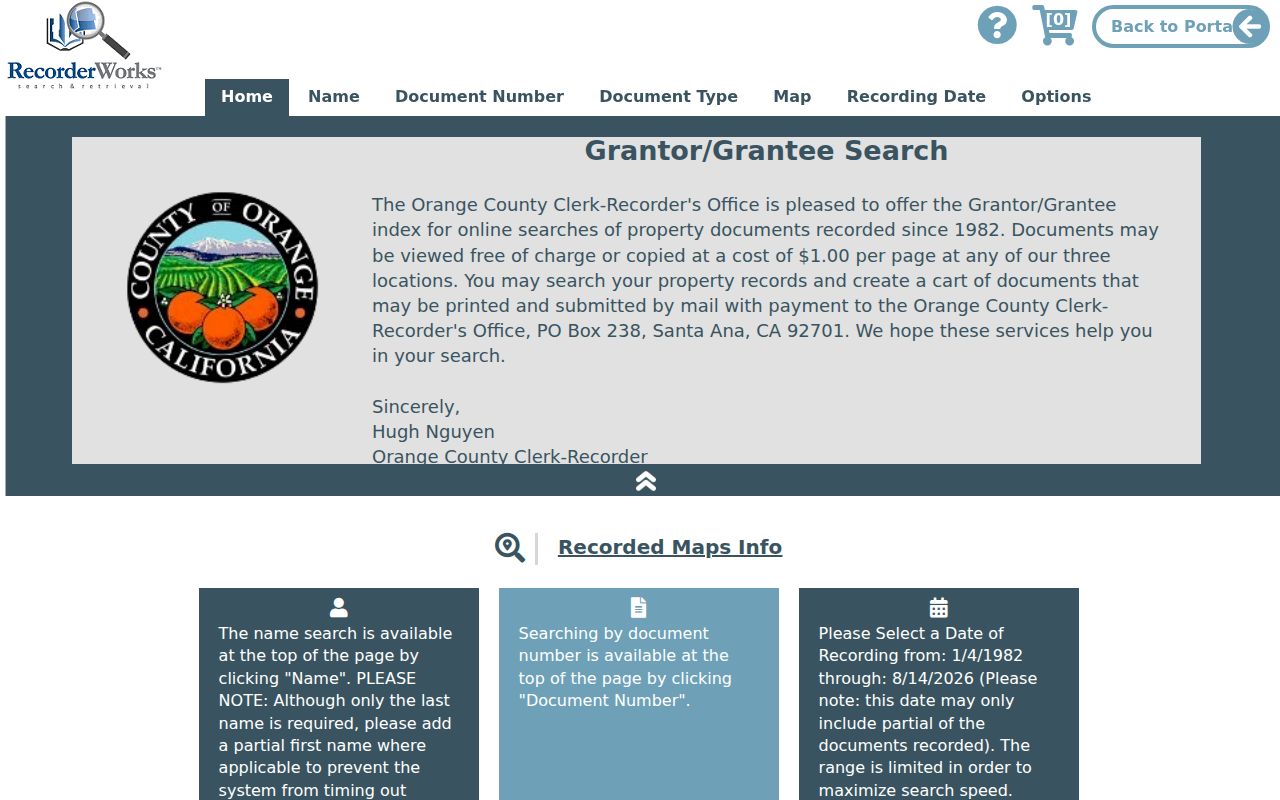
The index image shows the starting point for a deed chain. It is a pointer, not the recorded page itself.
After finding the instrument number, use the Orange County official-copy instructions for regular or certified copies and the mail route.
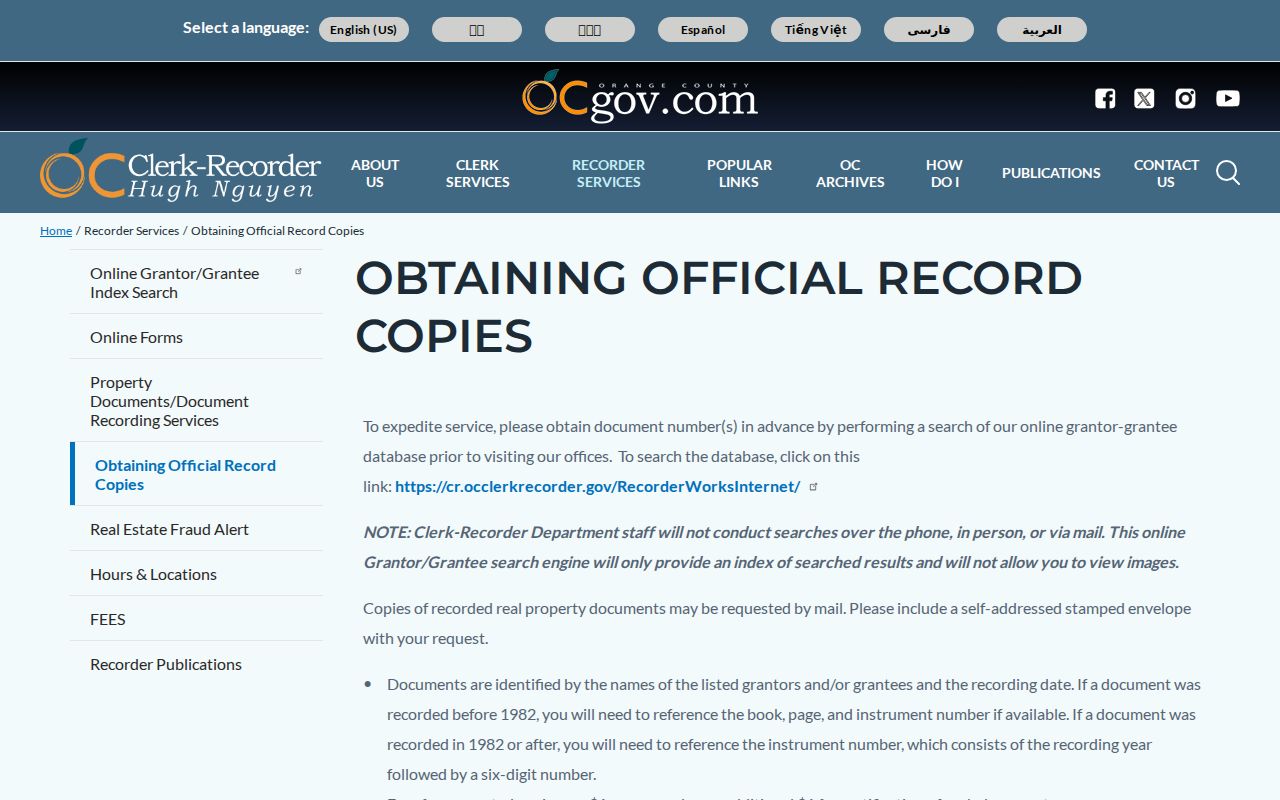
The copy-instructions image completes the index-to-record path. The web index identifies the deed; the custodian supplies the official copy.
Anaheim Grantor to Prior Grantee
The backward chain is a repeat of one careful move. Take the current acquisition deed's grantor, search that person as grantee in an earlier period, and identify the next seller. Repeat until the online cutoff or the available historical index stops the path. Use APN, legal description, date, and document type to separate same-name people and unrelated parcels.
- Resolve the modern address to APN, legal description, and situs fields.
- Obtain the fuller current owner field through the Assessor's counter or written route.
- Search the owner as grantee and save the acquisition instrument number.
- Read the grantor from the indexed deed and search that name as an earlier grantee.
- Repeat, then move to book and page indexes for the pre-1982 period.
- Pair title parties with directories, census, newspapers, and probate before calling them previous residents.
- Grantor
- The party transferring an interest in the recorded instrument.
- Grantee
- The party receiving an interest in the instrument.
- Chain of title
- The linked sequence of recorded transfers for a parcel.
- Legal description
- The land description used to test parcel continuity apart from a street name.
Cross the 1982 Anaheim Digital Boundary
For a pre-1982 deed, the web index is not the end of the search. Bring any book, page, instrument, map-book, tract, or legal-description clue to the Clerk-Recorder or Archives route. Orange County's conservation project documented property index volumes from 1889 through 1953 and repaired 60 heavily damaged deeds. The exact bridge for 1954-1981 should be confirmed with Archives staff.
Orange County Archives is at Old Courthouse Room 108, 211 W. Santa Ana Boulevard, Santa Ana. The research notes list hours of Monday through Friday, 9 a.m. to noon and 1 to 4:30 p.m., with (714) 834-2536 and archives@rec.ocgov.com. Most county records there are pre-1960. Bring the modern parcel and any deed number so staff can distinguish a tract from a similar name.
Archive bridge. The 1889-1953 property-index conservation project gives the backward trail a documented starting span, but it does not publish every 1954-1981 index detail.
Review the Orange County Archives access route before planning an in-person search.
Anaheim Directories for Occupants
Title records answer who transferred land. A city directory can answer who was listed at an address in an edition. The Anaheim Heritage Center reports an Anaheim and Orange County directory shelf from 1899 to the present. The digitized 1872-1948 title adds earlier pages, while reverse or criss-cross sections can move from an address to a listed occupant or business.
Record the exact year, address, name, occupation or business, spouse mark, and volume abbreviation. Compare adjacent years. Then test the name against a newspaper, census, permit, obituary, or family collection. A directory entry can be a strong occupancy clue, but it is still a time-bound listing and may omit household members.
The Anaheim city directory collections page explains the shelf, OCR, and entry-reading method. This previous-residents trail uses those books to support one address rather than repeat their full collection history.
Pair Anaheim Addresses with Released Census Households
Federal census schedules from 1850 through 1950 are presently public under the 72-year rule. A directory can bridge the years between those ten-year snapshots. Use a directory address to locate a likely census household, then compare names, ages, relationships, and street context. A disagreement can signal a move, a boarder, a different enumeration date, or a same-name error.
A simple process flow is directory year to address, address to census, census household to newspaper or deed, then source check. Do not use the census to fill a directory gap without reading the address and household fields. Older Anaheim research may also cross the Los Angeles County and Orange County boundary, so county custody must match the year.
Use the National Archives census guidance for the release framework, then return to the local shelf for the address source.
Date Anaheim Changes with Permits and Maps
Anaheim's historic-research guide says Building Division permits are available for permits issued after 1950. The issued or finaled permit report can show address, APN, work description, dates, value, owner-builder flag, and contractor fields. Use it to date a construction or alteration event, not to claim that an applicant was a resident.
The Heritage Center also supplies Sanborn maps, surveys, newspapers, images, and tax records. Exact Anaheim sheet years are not published in the reviewed sources. A Sanborn map can show building footprint, use, address, and sometimes a renumbering clue. Pair it with a deed or directory before treating a physical change as a household event.
Note: A permit dates work on a parcel, while a directory or census is needed to support an occupant claim.
Bridge Anaheim's Renamed Streets
Historic address searches must account for verified street-name changes. Center Street is now Lincoln Avenue. Los Angeles Street is now Anaheim Boulevard. Pacifico Street became Gene Autry Way in 1991. Try the old and current form in directories, newspapers, and indexes. Preserve the parcel, legal description, or map clue when a street label changes.
The research did not verify a citywide house-number renumbering project or a precise date for the first two name changes. Do not invent one. The GIS annexation-date field can explain why an older source places a present Anaheim parcel under another jurisdiction or record series.
Anaheim Obituaries and Probate Endpoints
When a former owner has died, an obituary can connect a name to a spouse, relative, address, organization, or date. Probate petitions and notices can identify heirs, an estate, or a transfer that explains why a deed chain changes. Orange County Superior Court handles probate, while the Heritage Center's newspapers and local collections can add the family context.
Use the endpoint to verify a transition, not to publish every personal detail. Compare the probate or obituary with the deed, directory, census, or cemetery record. A former resident may have left the address before death, and an estate record may list a mailing location rather than the property itself.
Lawful house history. A past-residents search can support genealogy and property history. Do not use personal records to stalk, harass, intimidate, or harm anyone.
Know the Verified Anaheim Era Gaps
The digital record has clear edges. RecorderWorks begins in 1982. The Archives has a documented 1889-1953 property-index span. The Heritage Center confirms directory and newspaper holdings, but exact publishers, every directory year, reverse-directory runs, tax books, water records, and Anaheim Sanborn sheet years remain unpublished in the reviewed sources. The permit guide gives an after-1950 line for building records.
State the gap in the research note. Ask Heritage Services Manager Jane Newell for the exact shelf inventory, and ask Archives staff for the 1954-1981 bridge. A previous-residents conclusion is stronger when it says which years were checked and which were not available than when it implies an unbroken chain.
A careful Anaheim previous-residents search ends with a source list: parcel, APN, owner field, instrument, directory year, census page, newspaper date, and custodian. That record lets a later researcher reproduce the trail without confusing a missing page with a missing person.